
Pesto alla Trapanese
When this Sicilian pesto sauce is good, it’s another level, and it’s all about the tomatoes. When they’re good, it beats its Genovese cousin hands down. It also has the advantage that, because of its reddish colour, it can be pasteurised without changing its appearance. The acidity of the tomatoes will have been diffused by the herbs and almonds, so even when pasteurised, I’d be inclined to keep it in the fridge – but it will be good for several months. Click here to view our Pesto alla Trapanese recipe.
Bottled tomatoes
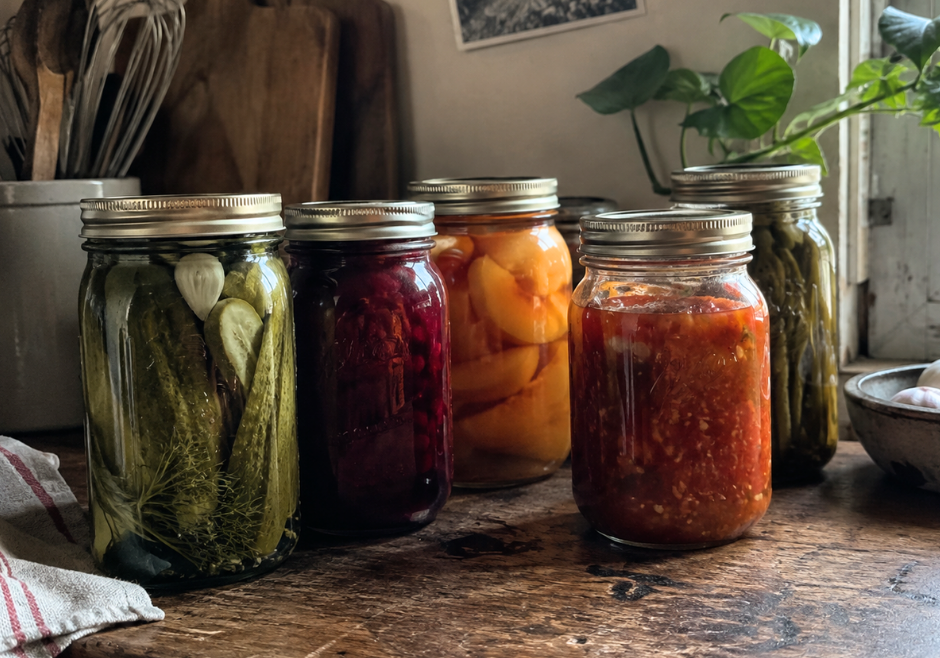
At our 40th anniversary field day, Pam (the Jam) Corbin gave a demonstration of how to bottle tomatoes. I was amazed that people actually asked what you’d do with a jar of tomatoes – not realising that they’re the same thing, but loads better, than the cans of toms we all use every week.
Those tend to be heated to a sterile 116°C, but home-preserved ones (with good acidity) only need gentle pasteurisation in a water bath to be fully ambient-stable. A splash of lemon juice or citric/ascorbic acid is an additional, if largely unnecessary, safety barrier. I’ve always found my tomatoes to register a pH much lower than the required 4.6, so I’ve never bothered. It’s satisfying to extend the preserving repertoire beyond pickles and jams to include a core, everyday ingredient such as tomatoes.
For a step-by-step method visit our website.
BFS Pomarola sauce
Prepping small cherry tomatoes for preserving is a bit of a nightmare, and peeling them is even worse. But I’ve found that tipping the whole caboodle (stalks and all) onto a roasting tray with olive oil, plenty of garlic, salt and rosemary until they’ve lost 30%+ of their weight, then putting them through a potato ricer/food mill, will give an intense, pomarola-type passata sauce that, once pasteurised, can be used throughout the year for pizzas, as a base for pasta and with Tuscan Panzanella salad. Quickly wash your cherry tomatoes and mix with 5% of their weight each of peeled garlic and olive oil, 1% rosemary leaves and a generous pinch of salt and pepper. Lay out on a baking tray and roast at 175°C for half an hour. Cool and sieve/mill/juice (you could probably use an electric juicer if you have one), then jar and pasteurise. If you get a bit of separation, with a layer of water at the bottom, just give it a shake.
Green tomato chutney
One of our favourite chutneys but, if the sunshine continues, likely to be an endangered species this year. Well worth picking a few kilos of unripened fruit to make a batch at home.
My top chutney tip is that, if, like me, you like it fairly chunky, salt the vegetables first to draw out the liquid. That way, the cooking time will be much shorter (costing less), and the necessary reduction will happen before it turns into an amorphous sludge. Our recipe is here but feel free to experiment – particularly with the spices. Green Tomato Chutney really is a broad church.
The beauty of pasteurising
I know I’m always banging on about pasteurising, but I suspect that it’s a dying art that few bother with at home. Fair enough if you’re just making jams and English-style chutneys – as long as your Jars and lids are sterile, but the beauty of it is that it allows you to cut back on sugar, vinegar and salt. So a typical British chutney that wouldn’t have had much use beyond a cheese and chutney sarnie becomes much milder – almost a vegetable ‘side’ that will help see you through the barren winter months. In a nutshell: chutney becomes caponata.
Pam Corbin gives a pretty good method in her River Cottage Preserving book, but a decent digital thermometer for checking the core temperature is a big plus. I’ve managed for years without a set of those clamps for taking the jars out of the water bath – but if anyone feels like giving me a set for Christmas…
If you’re taking preserving and fermenting seriously, the other must-have tool is a pH meter. 4.6 is generally considered to be a safe pH for ambient storage after pasteurising, but commercial canners go for a slightly lower reading. Litmus strips work OK, but when you’re talking about decimal points, a digital one leaves less to the imagination. For liquids, they’re really not expensive – you can pick up a pretty decent one for around £30, but market leaders Hanna are a little more.