
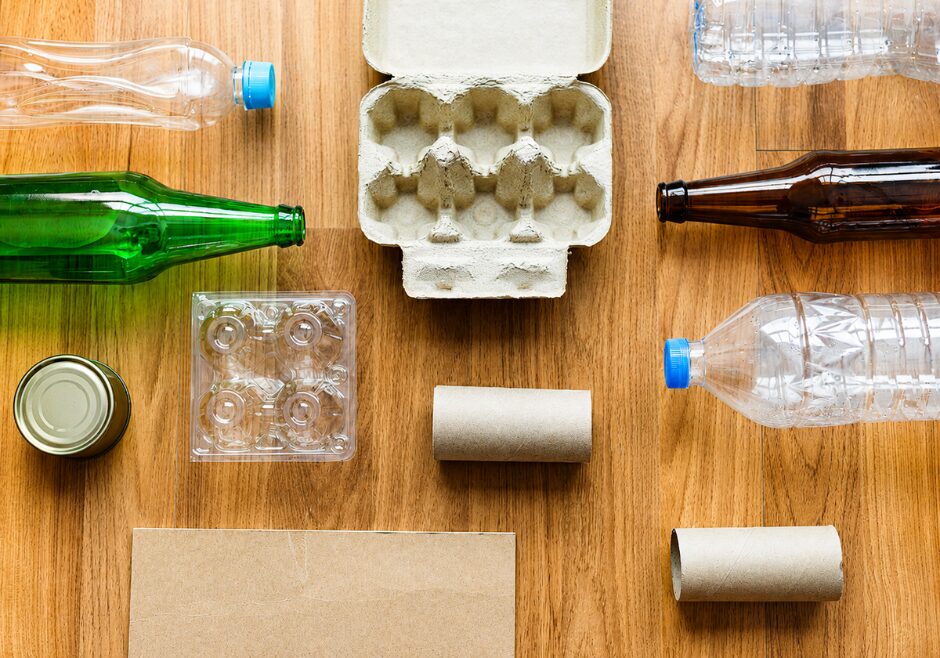
There is no single, simple solution to the world’s packaging problems – other than to buy less packaged product, which is easier said than done. I’m not sure how the zero-waste shops are doing but, worthy and worthwhile though they are, my guess is that any growth is slow and hard-earned. Buying less packaged produce has to be the first step. Then we’re left with a reduced burden of material to deal with: glass, aluminium, steel, plastics, paper and a number of wannabees and bit-part players.
In GHG terms, glass is definitely the worst. It’s heavy and requires ultra-high temperatures (1,500°C – slightly lower for recycling) compared with super-light aluminium, which only needs to be heated to around 600°C. Both aluminium and steel are easily recycled but are almost invariably lined with BPA or bisphenol. Apparently, there are naturally derived alternatives – oleoresin, for example – but I imagine they’re more expensive. Recycling aluminium and steel is well established and works. It’s so much better than glass but both still have that down-market feel that’s difficult to shake off. With the necessary will, all three could be returned, reused or recycled as part of a German ‘Pfand’-type system where deposits are charged and refunded on return. But it has had its challenges and, from what I can gather, it’s still down to the drinks producer to do the bottle washing – which is hard to see happening, exacerbated by the across-the-board lack of uniformity in sizes and shapes.
Paper often gets the Luddite’s vote and has its uses, but let’s face it, unless it has a coating of something questionable, it’s pretty useless. It also has a surprisingly high carbon footprint. Which leaves us with plastic and bioplastic. Bioplastics promise much but, so far, have delivered little. They account for just 2% of the market and I wouldn’t mind betting that every application comes with its own problems. For example, I’m told Riverford, who took the plunge for all the right reasons, at considerable expense, have had issues with their ‘No Ordinary Plastic Bags’ and I, for one, haven’t had a lot of joy composting them. They (bioplastics in general) are expensive and, unless made from waste feedstock, will be competing for land use if they ever do need to scale up. We might end up with feed for livestock competing with bioplastics for land.
As a potential small-scale user, it feels as though there is a lack of commonality in the bioplastics sector, with specific products being developed for specific uses and, obviously, those uses are determined by the big players. It’s all pretty inaccessible for minnows like us. Mind you, it’s still early days and I’m sure things were much the same with conventional plastics three-quarters of a century ago.
Not surprisingly, having spent a lifetime in the food business, I love plastic. It’s wonderful stuff – until it becomes waste, and then it’s not wonderful at all. It’s a nightmare. There might be some undiscovered, catch-all plastic-eating bacteria or fungi out there but I’m not holding my breath. In typical free-market fashion, waste-to-energy incinerators were briefly thought to be the answer by some fairly ethical countries such as Norway, Sweden and Japan but they should never have been seen as the only solution. As coal has been phased out, they’ve been discredited as ‘dirty energy’ – on a par with oil-fired power stations – so, although burning 15% might be justifiable, 100% is definitely not. I still think they should be part of the solution, but not at the cost of the three Rs: reducing, reusing and recycling. Yes, the energy produced is on a par with oil in emissions terms, dirtier than gas, but far cleaner than wood and coal. But when you look at the environmental advantages of taking all that waste plastic out of the oceans and landfill, it becomes far more palatable. Of course, they’re really only part of the final solution, after the three Rs – to which I would add a fourth: redesigning. There’s an awful lot of plastic packaging out there that is completely over-specified. Skincare and household cleaning products spring to mind – but, being in the food business, I would say that, wouldn’t I?
Last year, I mentioned the Global Plastics Treaty, unfortunately stalled by the refusal of so-called ‘low-ambition nations’ (of which Trump’s USA is a newly recruited member) to accept that limits have to be set on virgin plastic production. It’s always going to be cheaper so, unless it’s rationed in some way, there’s no incentive to reuse and recycle. There probably also needs to be a universal carbon emissions tax on waste-to-energy incinerators, which I believe is happening in Europe and, on a more piecemeal basis, in the UK. WtE needs to be the final step of a long staircase, after all reuse and recycling options have been exhausted.
Lastly, and probably most importantly, we all need to stop being so unrealistically demanding about what we actually need. Craft gin doesn’t taste any better out of an expensive, bespoke bottle and, I’m no expert, but to give a badly researched example, the primary function of a milk bottle is to hold liquid and not leak. Oxygen barriers that give it a three-week shelf life are good but not essential when most milk is consumed within a few days. In fact, they’re mainly there for the benefit of the dairy processing and distribution sectors, not us end users. The cost of those extra few days’ life is various laminates, coatings and additives that often make the plastic difficult to recycle and, in all likelihood, aren’t doing good things for our health. I’m not in denial, but that’s a subject for another day.