
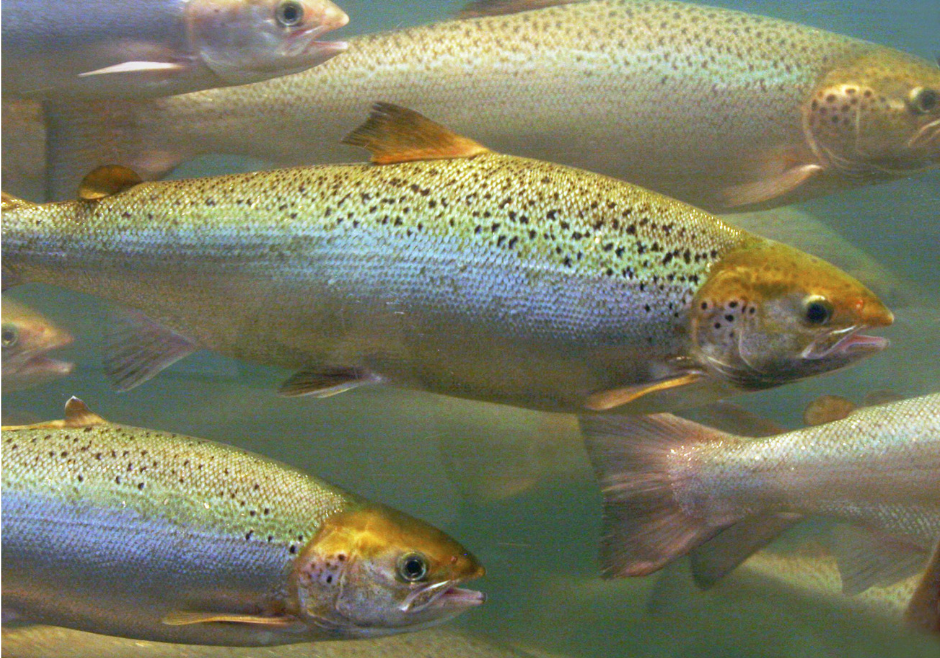
Sod’s law; just when we’re offering our all–singing, all-dancing smoked organic salmon for your delectation this Christmas – low and behold – it turns out not to be organic after all.
Before I get started on the issue, it’s not really relevant to the environmental and welfare side, but I’d like to say that Scottish (and probably elsewhere) salmon farming represents one of the most egregious cases of multinational interests riding, slipshod over environmental and local economic concerns I’ve come across and, in these days of devolution and ‘taking back control’ it really should be made a test case for some sort of, more inclusive, new economic order. As things stand, beyond a few expensive dinners for politicians in Edinburgh, I r4eally can’t see what benefits salmon farming is bringing to Scotland.
Much has already been written, and spoken, about the Soil Association’s commendable, but belated, decision to withdraw certification from all farmed salmon products – so I thought I’d better get my two-pennyworth in. I agree completely with what my brother wrote (in Wikileeks) that organic salmon should never have been certified in the first place. He also went off on one about the a, already well publicised horrors of the industry; implying strongly that it should be banned – which might be true but isn’t going to happen and isn’t really what this particular argument is all about. It’s about whether any farmed salmon is good enough to be called organic, and in a wider context, whether there has to be an organic version of everything. Soil Association president Helen Browning, who, incidentally, is still selling organic smoked salmon (not certified by the SA) on her website, appeared to be rather lamely saying on Radio 4’s Today program that they always knew there were problems but they thought they’d give the industry a chance to sort them out. Thirty years later, they hadn’t, so, after a two-year review, they’ve stopped certifying them. Commendable though it might be, I don’t think the SA comes out of it smelling of roses. Firstly, for taking thirty years and secondly, according to campaigning group, Wildfish, for not releasing some of the reports used in their review. Lack of transparency almost always implies a degree of skulduggery and in this case, it points towards ‘looking the other way’ and waiting for things to get better, on an epic scale, for a very long time. I’m sure many, non-corporate, land-based farmers would appreciate such benevolence.
So where does it leave us and do we have to have farmed salmon in the first place. It’s obviously a matter of personal choice but banning it really wouldn’t be that different to banning intensively reared chicken – which, let’s face it isn’t going to happen. We all know how bad large-scale salmon farming can be. I find the MSC website quite unrewarding so I’ve taken to getting my fish facts from Monterey Bay Aquarium based Seafood Watch, which gave the Scottish salmon farming industry (excluding the Orkney and Shetland Islands) a disastrous. 1.43-1.73 (out of 10). Norway did much better, but hardly distinguished itself, with an average score of about 3 while the Faroe and Orkney Islands scored an ‘acceptable alternative’ 4.3.
Concerns over salmon, and other fish, farming falls into four main areas; welfare, chemical, food and faeces pollution, escapees and biodiversity and the sustainability of feed supplies. Welfare is, to a degree, subjective. Organic stocking rates of 10kg of fish per cubic metre of water (approx. 1% by volume) don’t sound too bad – compared with what you see in intensive pig and chicken production where animals hardly have room to move. Swimming around in circles all day sounds a tad unrewarding but they’re big circles and, without being glib, that’s what fish do. Often the fish will be swimming against tidal and ocean currents so it’s relatively natural. At those sorts of stocking rates (40-50% of the norm) I’d put it on a par with free range pig and chicken farming – outdoors, but fenced in. Enclosing a naturally migratory species is a bit more questionable, as are the fatality rates, sometimes exceeding 50%, on many salmon farms. But better and less intensive salmon farms claim a ‘pre harvest’ mortality of less than 10% – which I’d have thought would be similar to intensive poultry farming. More questionable is enclosing a naturally migratory species – which, to me, just doesn’t feel right. But in the bigger picture of what happens in agriculture, zoos and, even, at home (with pets – not children), is more a question for the purists, but still a good reason why salmon farms should never have been given organic status in the first place.
Chemical and faeces pollution is probably the issue that causes the most concern. Depending on which side you’re listening to, impact on inshore fisheries have been anything from negligible to catastrophic. Having talked to local crab and lobster fishermen in Connemara a few years ago I’d be more inclined to believe the latter – and don’t forget that this is still a comparatively new industry. The worst is almost certainly yet to come. Maybe they’ll sort out the need for chemical lice treatments but I really can’t see what they can do about the faeces. Obviously the lower the stocking rates and the longer the pens are left fallow between batches, combined with currents and tidal flows, could be make or break.
The great escape; farmed salmon do escape. When I was looking onto it a couple of years ago, it wasn’t hard to find an instances of mass (5,000 plus fish) escapes. If there’s a major storm, hundreds of thousands of fish might escape from multiple sites. The results can be catastrophic; breeding with slower growing wild fish will produce offspring genetically unsuited to life on the run, escaped fish will compete for limited food, to the cost of the indigenous salmon and sea trout populations, sea lice and disease will spread and local ecosystems will be disrupted putting pressure on a whole spectrum of vulnerable species. And that’s before we get on to the converse issues around the introduction of so-called ‘cleaner’ fish such as lumpfish and wrasse.
Lastly, salmon are carnivorous and once they’ve migrated to the sea (approximately half way through their lives), live off small fish, crustaceans, cephalopods etc. Organic reg’s stipulate fish from sustainable fisheries, by-catch or by-products from fish processing and non-GMO organic plant based ingredients. For conventional salmon, replicating that diet has involved hoovering up vast quantities of krill, sand eels and other small fish and, up until very recently, anchoveta from the previously extraordinarily rich fishery off the coast of Peru. That’s pretty much fished out so they’re looking elsewhere and for alternative sources of proteins and oils – often from non-aquatic sources. Although previously banned, chicken bi-products (skin, bone, blood etc) are finding their way into salmon food. It’s a tricky one. If you chucked a dead chicken into a shark tank, you wouldn’t be surprised to see it get eaten – but, somehow, you’d expect salmon to be a bit pickier. And, obviously, the less fish the salmon are fed, the less omega 3 oils we’ll get from eating them. But either way, it would be a one-off celebration and definitely not the same as being the main component of a salmon’s diet. For me, the jury’s out but after BSE, FMD, bird flu, Ebola and COVID, it’s not one that I’d feel safe giving commercial interests a free rein to do what they like.
So, all in all, it does seem pretty crap. But does it have to be? On land, organic seems to have been succeeded by regenerative but I’m not sure what regenerative salmon farming might look like. Things are changing but in a questionable direction. When I looked into it a year or so ago, our suppliers had just started working with land based salmon farms in Iceland. Instead of rearing the smoults in fresh water before transferring to sea pens, the fish are put in enclosed, land based, salt water pens that look a bit like gas storage tanks. Effluent is filtered out and clean water returned to the sea and replaced. In such sterile conditions, sea lice aren’t a problem and mortality is as low as 2%. Escapees obviously don’t get very far. From a pollution point of view, it sounds great and many retailers (veg box company Abel & Cole for example) are switching to land produces salmon. But, but, but….. it doesn’t solve the feed problem and, as with zero grazed dairy herds, I’d be struggling to call it free range. In fact, stocking rates can be six time the organic rate (two and a half times the conventional). Harry, Mia and I share an office which, with the help of a tape measure and calculator, we worked out complies with organic salmon farming criteria. I’d like to think it’s acceptable but if we added another fifteen people we’d be dancing on the ceiling? I don’t think so.
In Alaska salmon farms are banned. The annual migratory cycle is kept topped up by continually releasing smoults as the young fish head out to sea. I’m not sure who pays for it. They call it sea ranching and, obviously, once released, the fish are subject to the same predators. as wild salmon and, as with wild fish, only a tiny percentage make it back to breed. But it seems to work – as all the hullabaloo about the Fat Bear Week video feed on social media has shown. I’m not sure why sea ranching hasn’t been tried with Atlantic salmon but you’d have thought that where there is a will there should be a way.
The other option might be the ‘boutique’, high welfare salmon farm. I’ve already had my wrists, metaphorically, slapped a few times for threatening to buy VAR salmon from the Faroe Isles. Despite the horrors of the grindadráp (whale hunt), some of the smaller salmon farms do appear to be doing a pretty good job. Low stocking rates, strong currents, lengthy fallow periods and, most interestingly, late release of, much larger than average, smoults limiting the time at sea when the fish can be attacked by lice. I’m not sure how low the price of mass produced salmon is but VAR salmon is about 20% cheaper than organic so really not massively expensive. As said earlier, like intensive poultry and pig farms, I really can’t see salmon farming going away so, as with chicken farms, it needs to be properly regulated and controlled- most importantly at the planning stage. Looking at a map, it’s really not rocket science to conclude that the Irish Sea and seas around the Inner Hebrides aren’t ideal locations for a concentration of salmon farms. Currents might whoosh along but with so many farms, I’d imagine it’s just carrying pollution from one site to the next before spewing what’s left out into the North Atlantic. The Faroes, Orkneys and Shetlands seem like better locations – but only until they’re not i.e. when the numbers exceed the localities ability to disperse the various emissions in an environmentally acceptable way. The same rules should be applied to chicken farms in the Wye Valley and elsewhere.
In a nutshell the conundrum for salmon farms is the same as for intensive livestock farms and most would be solved if we all ate a lot less meat and fish.
And what are we (Ben’s Farm Shops) going to do about it. Hopefully we’ve earned your trust over the years – to find the best (on all fronts) food for you to buy and eat. It could be that you stop buying the salmon offered in the shops – in which case we’d drop it – but, in the meantime, we’ll go on looking for the best available. If they can’t call it organic then so be it. I’ve always had my doubts whether the Irish Channel is the best place for a fish farm and the waters between the inner and Outer Hebrides is definitely over farmed, so we’ll look elsewhere. As mentioned, the Orkneys, as a whole, gets quite good ratings so I’d imagine the better, previously Soil Association organic certified, farms would be considerably better. So that’s where we’ll look – until you tell us not to.